Resistive response associated with adsorption and desorption mechanisms in molybdenum dioxide thin films
DOI:
https://doi.org/10.47566/2026_syv39_1-261101Keywords:
MoO2 thin films, Gas sensing, Adsorption–desorption, Resistive response, Metal oxide, Surface interactionsAbstract
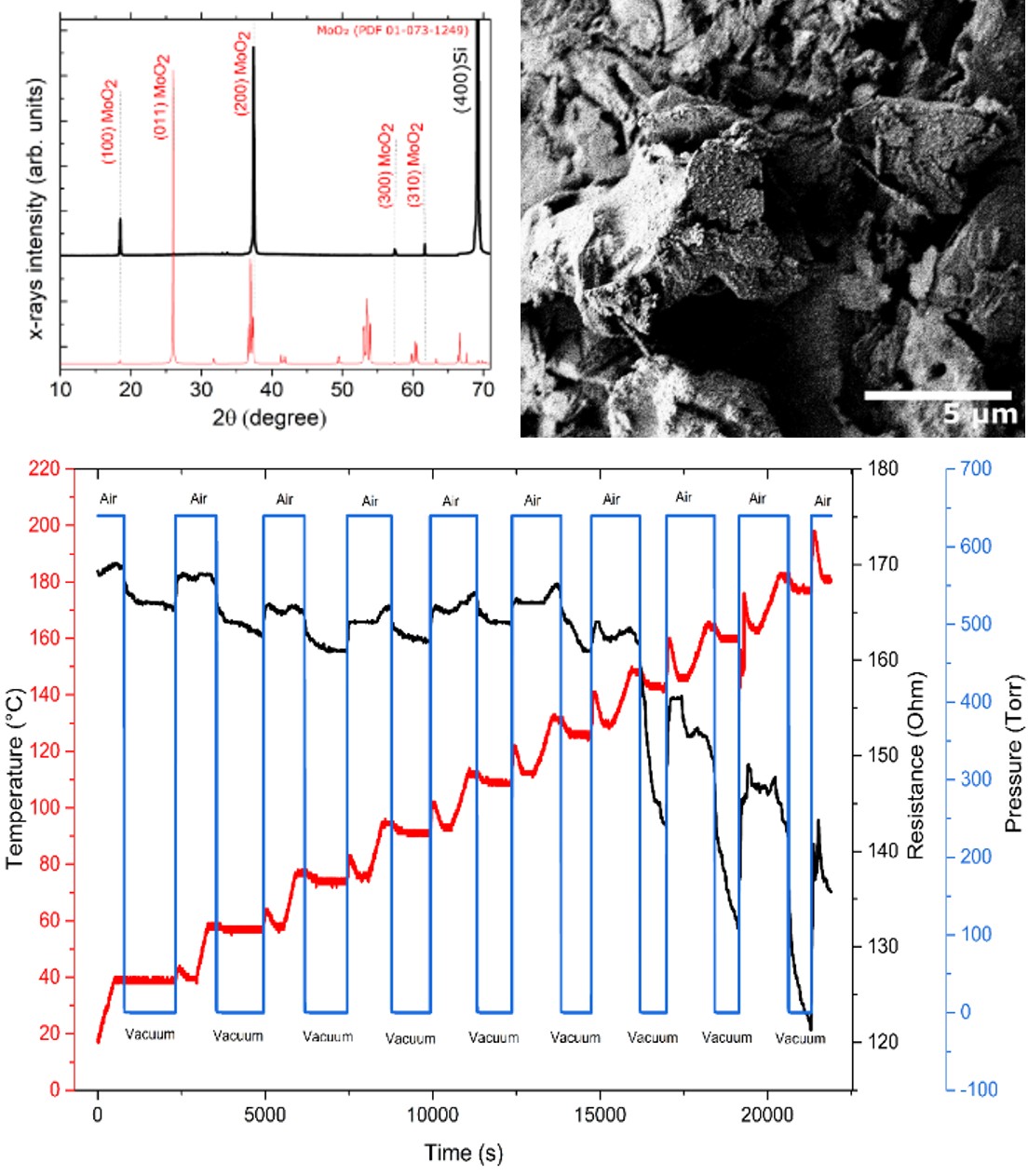
This work investigates the resistive response associated with adsorption and desorption processes in molybdenum dioxide (MoO2) thin films. The films were grown by isothermal closed-space vapor transport and characterized by X-ray diffraction, Raman spectroscopy, and scanning electron microscopy, confirming the formation of monoclinic MoO2 with a heterogeneous morphology. Electrical resistance measurements were performed as a function of temperature and pressure under controlled atmosphere conditions, including air and vacuum environments. The results reveal a non-monotonic temperature dependence of resistance, with a transition around 80 °C associated with the onset of oxygen desorption. Dynamic measurements under alternating air-vacuum cycles show two distinct regimes: at low temperatures, the response is dominated by intrinsic thermal transport, while at higher temperatures, surface chemical processes govern the resistive behavior. This transition reflects the competition between thermally driven charge transport and adsorption–desorption mechanisms. These findings provide insight into the role of surface states and microstructure in modulating the electrical response of MoO2, highlighting its potential as an active material for resistive gas sensing applications.
Downloads
References
[1]. Z. Wang, M. Bu, N. Hu, L. Zhao, “An overview on room-temperature chemiresistor gas sensors based on 2D materials: Research status and challenge” Compos. B: Eng. 248, 110378 (2023).
https://doi.org/10.1016/j.compositesb.2022.110378
[2]. A. Mirzaei, J.-H. Lee, S.M. Majhi, M. Weber, M. Bechelany, H.W. Kim, S.S. Kim, “Resistive gas sensors based on metal-oxide nanowires” J. Appl. Phys. 126, 241102 (2019).
https://doi.org/10.1063/1.5118805
[3]. S.M. Kanan, O.M. El-Kadri, I.A. Abu-Yousef, M.C. Kanan, “Semiconducting Metal Oxide Based Sensors for Selective Gas Pollutant Detection” Sensors 9, 8158 (2009).
https://doi.org/10.3390/s91008158
[4]. N. Barsan, U. Weimar, “Conduction Model of Metal Oxide Gas Sensors” J. Electroceramics 7, 143 (2001).
https://doi.org/10.1023/A:1014405811371
[5]. N. Yamazoe, “New approaches for improving semiconductor gas sensors” Sens. Actuators B: Chem. 5, 7 (1991).
https://doi.org/10.1016/0925-4005(91)80213-4
[6]. J. Huang, Q. Wan, “Gas Sensors Based on Semiconducting Metal Oxide One-Dimensional Nanostructures” Sensors 9, 9903 (2009).
https://doi.org/10.3390/s91209903
[7]. P. Najafi, A. Ghaemi, “Chemiresistor gas sensors: Design, Challenges, and Strategies: A comprehensive review” Chem. Eng. J. 498, 154999 (2024).
https://doi.org/10.1016/j.cej.2024.154999
[8]. K.W. Harrison, C.D. Corolewski, M.D. McCluskey, J. Lindemuth, S. Ha, M.G. Norton, “lectronic transport in molybdenum dioxide thin films” J. Mater. Sci.: Mater. Electron. 26, 9717, (2015).
https://doi.org/10.1007/s10854-015-3639-2
[9]. G. Zhuang, Y. Chen, Z. Zhuang, Y. Yu, J. Yu, “Oxygen vacancies in metal oxides: recent progress towards advanced catalyst design” Sci. China Mater. 63, 2089 (2020).
https://doi.org/10.1007/s40843-020-1305-6
[10]. T. Yunusi, C. Yang, W. Cai, F. Xiao, J. Wang, X. Su, “Synthesis of MoO3 submicron belts and MoO2 submicron spheres via polyethylene glycol-assisted hydrothermal method and their gas sensing properties” Ceram. Int. 39, 3435 (2013).
https://doi.org/10.1016/j.ceramint.2012.09.096
[11]. O. de Melo, L. García-Pelayo, Y. González, O. Concepción, M. Manso-Silván, R. López-Nebreda, J.L. Pau, J.C. González, A. Climent-Font, V. Torres-Costa, “Chemically driven isothermal closed space vapor transport of MoO2: thin films, flakes and in situ tellurization” J. Mater. Chem. C 6, 6799 (2018).
https://doi.org/10.1039/c8tc01685b
[12]. R.M. German, Sintering Theory and Practice (Wiley, 1996).
ISBN: 978-0-471-05786-4 https://www.wiley.com/en-us/shop/general-introductory-materials-science/sintering-theory-and-practice-p-9780471057864
[13]. J. Zhang, F. Huang, Z. Lin, “Progress of nanocrystalline growth kinetics based on oriented attachment” Nanoscale 2, 18 (2010).
https://doi.org/10.1039/b9nr00047j
[14]. G. J. Norga, L. Fé, F. Vasiliu, J. Fompeyrine, J.-P. Locquet, O. Van der Biest, “Orientation selection in functional oxide thin films” J. Eur. Ceram. Soc. 24, 969 (2004).
https://doi.org/10.1016/S0955-2219(03)00405-9
[15]. Z. Cheng, X. Wang, J. Gao, M. Wang, A. Wang, H. Bo, Z. Guo, W. Zou, X. Ma, “Deposition and structural investigation of uniform AlN(100) films at wafer scale through RF magnetron sputtering” Ceram. Int. 50, 28601 (2024).
https://doi.org/10.1016/j.ceramint.2024.05.170
[16]. M. Dieterle, G. Mestl, “Raman spectroscopy of molybdenum oxides: Part II. Resonance Raman spectroscopic characterization of the molybdenum oxides Mo4O11 and MoO2” Phys. Chem. Chem. Phys. 4, 822 (2002).
https://doi.org/10.1039/b107046k
[17]. M.A. Camacho-López, L. Escobar-Alarcón, M. Picquart, R. Arroyo, G. Córdoba, E. Haro-Poniatowski, “Micro-Raman study of the m-MoO2 to alpha-MoO3 transformation induced by cw-laser irradiation” Opt. Mater. 33, 480 (2011).
https://doi.org/10.1016/j.optmat.2010.10.028
[18]. O. de Melo, Y. González, A. Climent-Font, P. Galán, A. Ruediger, M. Sánchez, C. Calvo-Mola, G. Santana, V. Torres-Costa, “Optical and electrical properties of MoO2 and MoO3 thin films prepared from the chemically driven isothermal close space vapor transport technique” J. Phys. Condens. Matter. 31, 295703 (2019).
https://doi.org/10.1088/1361-648X/ab18e2
[19]. G. Korotcenkov, “Metal oxides for solid-state gas sensors: What determines our choice?” Mater. Sci. Eng. B 139, 1 (2007).
Downloads
Published
Issue
Section
License
Copyright (c) 2026 The authors; licensee SMCTSM, Mexico.

This work is licensed under a Creative Commons Attribution 4.0 International License.
©2026 by the authors; licensee SMCTSM, Mexico. This article is an open access article distributed under the terms and conditions of the Creative Commons Attribution license (http://creativecommons.org/licenses/by/4.0/).