Influence of Fe3O4 particles in Al7075 metal matrix composites: A Tribological study
DOI:
https://doi.org/10.47566/2026_syv39_1-260301Keywords:
Wear rate, frictional force, Al7075- Fe3O4 Composite, Taguchi orthogonal approach, ANOVAAbstract
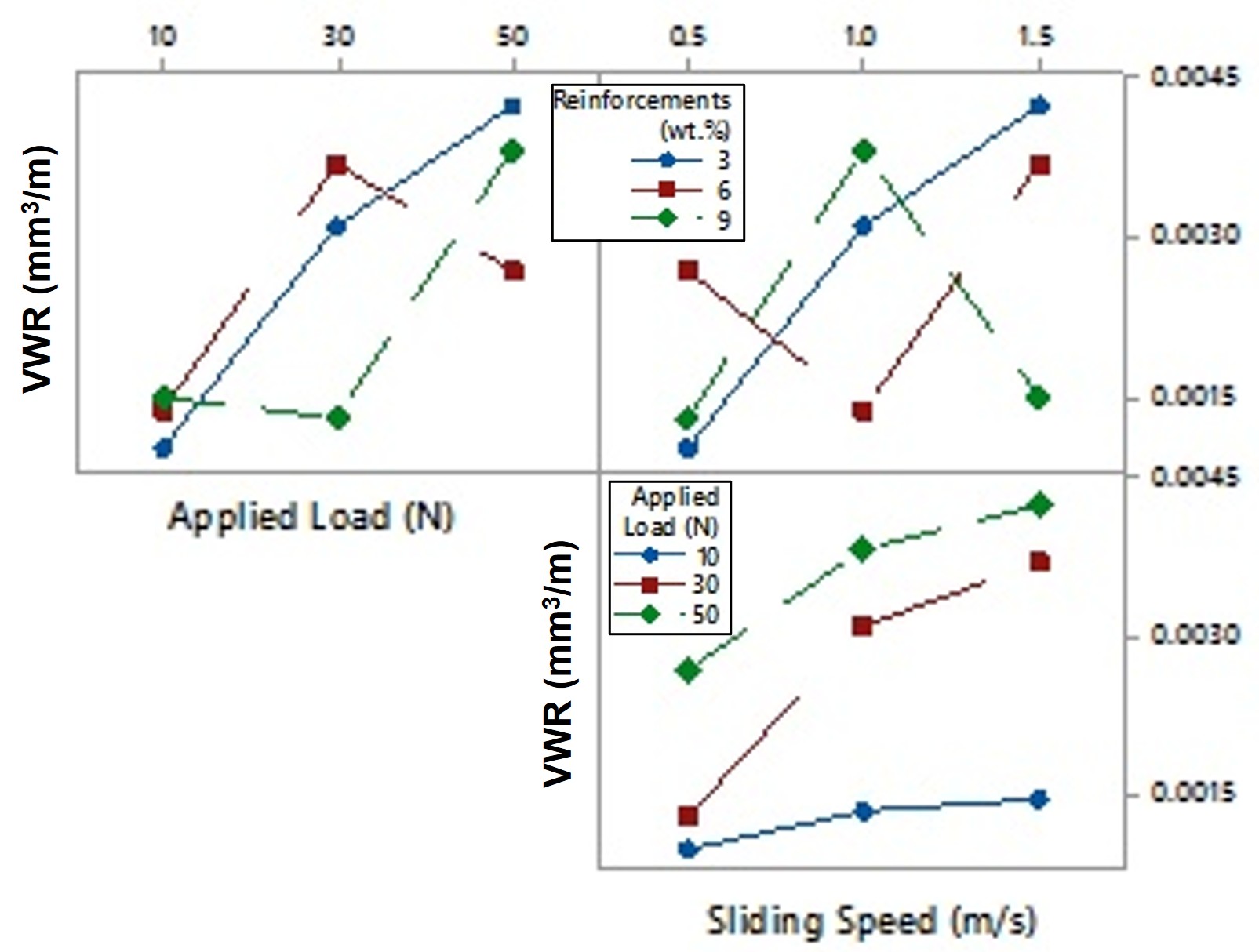
Due to their widespread use in the automotive and aerospace industries, among many other engineering applications, aluminum metal-matrix composites are attracting a lot of research interest. Its low wear rate and excellent strength make it the favored alternative. The main objective of this research project is to create metal-matrix composite materials by utilizing Fe3O4 as a reinforcing element and aluminum alloy 7075 as the matrix material. This study examined the dry sliding wear behavior of Al7075 alloy reinforced with varying weight proportions (3%, 6%, and 9%) of Fe3O4 (Magnetite) on composite samples using a pin-on disc apparatus. The composite was maintained unlubricated, and the volumetric wear rate by the pin-on disc wear machine in moist air was measured. The sliding speeds ranged from 1 to 3 m/s for a constant sliding distance of 1500 meters. The coefficient of friction decreased as the reinforcement percentage of Fe3O4 increased in the aluminum matrix, and also, volumetric wear loss increased as the load increased. The wear tests were carried out using the Taguchi orthogonal approach for reducing the trials of the experiments and to optimize the wear rate and frictional force of Al7075-Fe3O4 composite. A mathematical model was obtained to determine the wear rate and frictional force of Al7075-Fe3O4 composite.
Downloads
References
[1]. G.E. Kiourtsidis, S.M. Skolianos, “Wear behavior of artificially aged AA2024/40 µm SiCp composites in comparison with conventionally wear-resistant ferrous materials”, Wear 253, 946 (2002).
https://doi.org/10.1016/S0043-1648(02)00216-8
[2]. M. Muratoglu, M. Aksoy, “The effects of temperature on wear behaviors of Al–Cu alloy and Al–Cu/SiC composite”, Mater. Sci. Eng. A 282, 91 (2000).
https://doi.org/10.1016/S0921-5093(99)00767-4
[3]. P.H. Shipway, A.R. Kennedy, A.J. Wilkes, “Sliding wear behavior of aluminum-based metal matrix composites produced by a novel liquid route”, Wear 216, 160 (1998).
https://doi.org/10.1016/S0043-1648(97)00153-1
[4]. S.C. Lim, M. Gupta, L. Ren, J.K.M. Kwok, “The tribological properties of Al–Cu/SiCp metal–matrix composites fabricated using the rheocasting technique”, Mater. Process. Technol. 89-90, 591 (1999).
https://doi.org/10.1016/S0924-0136(99)00067-9
[5]. Y. Sahin, “Wear behavior of aluminum alloy and its composites reinforced by SiC particles using statistical analysis” Mater. Des. 24, 95 (2003).
https://doi.org/10.1016/S0261-3069(02)00143-7
[6]. D.P. Mondal, S. Das, A.K. Jha, A.H. Yegneswaran, “Abrasive wear of Al alloy–Al2O3 particle composite: A study on the combined effect of load and size of abrasive”, Wear 223, 131 (1998).
https://doi.org/10.1016/S0043-1648(98)00278-6
[7]. A. Shivaramakrishna, R. Subramanya, Y. Basavaraj, “Tensile hardness and wear properties of iron oxide (Fe3O4) reinforced aluminum 7075 metal matrix composites”, Adv. Mater. Process. Technol. 8, 4598 (2022).
https://doi.org/10.1080/2374068X.2022.2079227
[8]. B.M. Gopalsamy, B. Mondal, S. Ghosh, “Taguchi method and ANOVA: An approach for process parameters optimisation of hard machining while machining hardened steel”, Int. J. Adv. Manuf. Technol. 43, 237 (2009).
https://doi.org/10.1007/s00170-008-1709-2
[9]. A. Shivaramakrishna, Y. Basavaraj, R. Subramanya, “Synthesis of Fe3O4–aluminum matrix composites: Mechanical and corrosion characteristics”, Int. J. Cast Met. Res. 35, 51 (2022).
https://doi.org/10.1080/13640461.2022.2078551
[10]. G. Straffelini, C. Giuliari, M. Pellizzari, E. Veneri, M. Bronzato, “Dry rolling-sliding wear of austempered cast iron”, Wear 271, 1602 (2011).
https://doi.org/10.1016/j.wear.2010.11.043
[11]. F.H. Stott, “The role of oxidation in the wear of alloys”, Tribol. Int. 31, 61 (1998).
https://doi.org/10.1016/S0301-679X(98)00008-9
[12]. J. Zhang, A.T. Alpas, “Transition between mild and severe wear in aluminum alloys”, Acta Mater. 45, 513 (1997).
https://doi.org/10.1016/S1359-6454(96)00191-0
[13]. M.A. Chowdhury, M.K. Khalil, D.M. Nuruzzaman, M.L. Rahaman, “The effect of sliding speed and normal load on friction and wear property of aluminum”, Int. J. Mech. Mechatron. Eng. 11, 53 (2011).
https://studylib.net/doc/18385951/the-effect-of-sliding-speed-and-normal-load-on-friction
[14]. R.A. Al-Samarai, Haftirman, K.R. Ahmad, Y. Al-Douri, “Effect of load and sliding speed on wear and friction of aluminum–silicon casting alloy”, Int. J. Sci. Res. Publications 2(3), 37 (2012).
https://www.ijsrp.org/research_paper_mar2012/ijsrp-Mar-2012-37.pdf
[15]. D. Nagesh, S. Raghavendra, N.M. Sivaram, S. Suresh, B. Manjunatha, S. Sanketh, “Tribological characteristics of Al6061, boron, and graphite hybrid metal matrix composites”, Adv. Mater. Process. Technol. 8, 3248 (2021).
Published
Issue
Section
License
Copyright (c) 2026 The authors; licensee SMCTSM, Mexico.

This work is licensed under a Creative Commons Attribution 4.0 International License.
©2026 by the authors; licensee SMCTSM, Mexico. This article is an open access article distributed under the terms and conditions of the Creative Commons Attribution license (http://creativecommons.org/licenses/by/4.0/).