Effect of astaxanthin concentration on the wear properties of castor oil and wear rate prediction using non-linear regression by pin-on-disk tests
DOI:
https://doi.org/10.47566/2026_syv39_1-261001Keywords:
Castor oil, Astaxanthin, Additive, Wear, Non-linear regressionAbstract
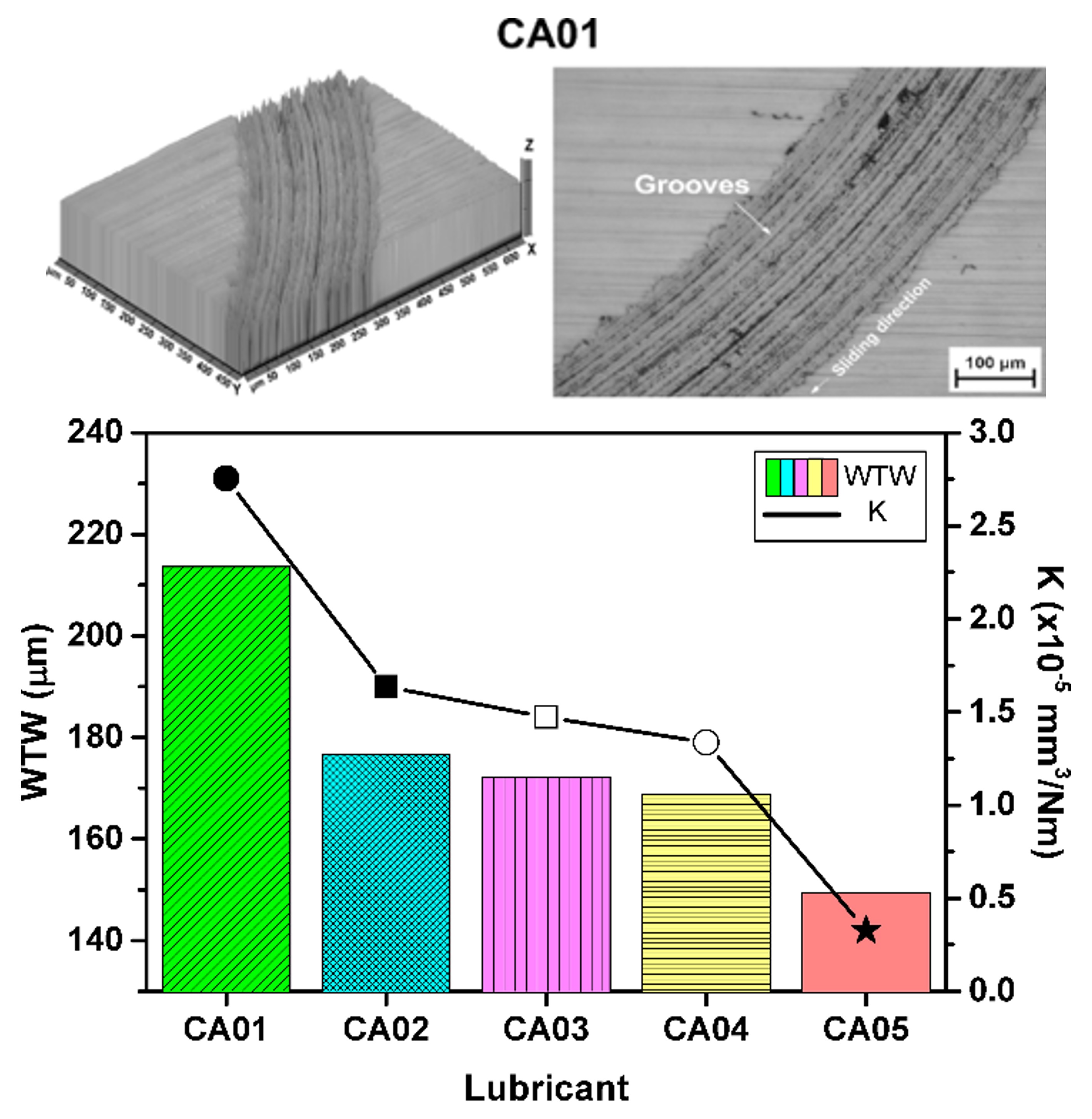
Numerous studies have aimed to identify biodegradable oils and additives as alternatives to mineral substances in industrial settings. Among these, castor oil combined with astaxanthin, a natural antioxidant, has demonstrated exceptional results compared to other substances. Consequently, this study examined the tribological performance of five mixtures of castor oil with different astaxanthin concentrations using sliding friction tests in a pin-on-disk tribometer based on the ASTM G99-23. For this purpose, steel disks of AISI 4140 and spheres of tungsten carbide (WC) with a diameter of 3 mm were used as counterparts. Each essay was performed by immersing the test specimens in the lubricant, controlling the temperature at 100 °C. The key finding is that the reduction in wear rate is directly affected by increasing astaxanthin concentration, which was observed in the wear mechanism. The correlation between wear rate and astaxanthin concentration was studied through a mathematical equation that estimates the value of the wear parameter at antioxidant concentrations beyond those tested experimentally. This achievement marks a significant milestone in applying statistics to complex systems, establishing a mathematical link between astaxanthin concentrations and wear properties.
Downloads
References
[1]. D.V.V. Monikandan, D.K. Pratheesh, C. Santulli, S. Digra, P.V. Prasanth, E.R. Dhas, “History of tribology: Assessing the prehistoric impacts, progress on industrial and scientific revolution eras, and contemporary interdisciplinary research trends” Tribol.: Finn. J. Tribol. 41, 4 (2024).
https://doi.org/10.30678/fjt.137828
[2]. E. Dogan, S. Yalçinkaya, M. Kurtulmus, An evaluation on the principles of tribology and usage in wear applications. In: Innovative Technology Applications in Engineering Sciences, Eds. R. Jain, A. Güllü, S. Yalçinkaya (GÜVEN PLUS, Istanbul, 2022) pp. 74-95.
https://www.guvenplus.com.tr/imagesbuyuk/56147iiii.pdf
[3]. M. Khadem, W.B. Kang, D.E. Kim, “Green Tribology: A Review of Biodegradable Lubricants – Properties, Current Status, and Future Improvement Trends”, Int. J. of Precis. Eng. and Manuf.-Green Tech. 11, 565 (2024).
https://doi.org/10.1007/s40684-023-00556-x
[4]. N.V. Minh, Al. Kuzharov, L.H. Ninh, N. Huynh, An. Kuzharov, Green Tribology. In: Tribology in Materials and Manufacturing - Wear, Friction and Lubrication, Eds. A. Patnaik, T. Singh, V. Kukshal (IntechOpen, London, 2021).
https://doi.org/10.5772/intechopen.94510
[5]. A. Acosta Valdés, J.A. Padilla Bautista, J.A. Zepeda-Domínguez, S. Ojeda-Benitez, “Percepción acerca del manejo responsable de los aceites lubricantes usados: una aplicación de red semántica natural” Rev. Int. Contam. Ambient. 40, 503 (2023).
https://doi.org/10.20937/RICA.55068
[6]. Secretaría de Medio Ambiente y Recursos Naturales (SEMARNAT), Empresas autorizadas para el manejo de residuos peligrosos, Gob.mx. [Access: May 11th, 2026].
https://www.gob.mx/semarnat/documentos/empresas-autorizadas-para-el-manejo-de-residuos-peligrosos
[7]. S. Nogales-Delgado, J.M. Encinar, J.F. González, “A Review on Biolubricants Based on Vegetable Oils through Transesterification and the Role of Catalysts: Current Status and Future Trends” Catalysts 13, 1299 (2023).
https://doi.org/10.3390/catal13091299
[8]. J. Pichler, R.M. Eder, C. Besser, L. Pisarova, N. Dörr, M. Marchetti-Deschmann, M. Frauscher, “A comprehensive review of sustainable approaches for synthetic lubricant components” Green Chem. Lett. Rev. 16, 1 (2023).
https://doi.org/10.1080/17518253.2023.2185547
[9]. M. Freschi, A. Paniz, E. Cerqueni, G. Colella, G. Dotelli, “The Twelve Principles of Green Tribology: Studies, Research, and Case Studies – A Brief Anthology” Lubricants 10, 129 (2022).
https://doi.org/10.3390/lubricants10060129
[10]. Y. Su, F. Chen, J. Chen, M. Wang, “An overview of potential cardioprotective benefits of xanthophylls in atherosclerosis: an evidence-based review” Food Sci. Hum. Wellness 13, 1739 (2024).
https://doi.org/10.26599/FSHW.2022.9250147
[11]. M.T. Hernández-Sierra, J.E. Báez, L.D. Aguilera-Camacho, J.S. García-Miranda, K.J. Moreno, “Friction and wear improvement by using Curcumin as a natural additive in green lubricants” Proc. Inst. Mech. Eng. J: J. Eng. Tribol. 237, 578 (2023).
https://doi.org/10.1177/13506501221121896
[12]. J.M. Liñeira del Río, A. Aourdou, G. García-Marquínez, J.M. Amado, M.J. Tobar, “Deep Eutectic Solvents as Green and Novel Lubricant Additives for Castor Oil with High Tribological Performance” Lubricants 13, 456 (2025).
https://doi.org/10.3390/lubricants13100456
[13]. D.F. Silva-Alvarez, I. Dominguez-Lopez, M.A. Vidales Hurtado, C. Gutierrez-Antonio, K.A. Flores-Garay, A.L. Garcia-Garcia, “A review on the menagerie of green fluids and nanoparticles to develop sustainable biolubricant technologies” Environ. Technol. Innov. 33, 103532 (2024).
https://doi.org/10.1016/j.eti.2024.103532
[14]. T.Y. Woma, T.D. Ipilakyaa, A.A. Abdullahi, A.S. Abdulrahman, M.A. Olutoye, S.A. Lawal, “Evaluation of Corrosion Inhibition, Thermo-Oxidative Stability, and Biodegradability of Castor Oil-Based Lubricant” Arid Zone J. Eng. Technol. Environ. 21, 328 (2025).
https://www.azojete.com.ng/index.php/azojete/article/view/1055
[15]. M.M.F. Melo Neta, R.R.C. Monteiro, P.R.C.F. Ribeiro Filho, C.L. Cavalcante, F.M.T. Luna, “Tribological Properties of Biolubricants: A Comprehensive Bibliometric and Trend Analysis” Lubricants 14, 77 (2026).
https://doi.org/10.3390/lubricants14020077
[16]. K.J. Moreno, M.T. Hernández-Sierra, J.E. Báez, E. Rodríguez-deLeón, L.D. Aguilera-Camacho, J.S. García-Miranda, “On the Tribological and Oxidation Study of Xanthophylls as Natural Additives in Castor Oil for Green Lubrication” Materials 14, 5431 (2021).
https://doi.org/10.3390/ma14185431
[17]. Y. Dang, Z. Li, F. Yu, “Recent Advances in Astaxanthin as an Antioxidant in Food Applications” Antioxidants 13, 879 (2024).
https://doi.org/10.3390/antiox13070879
[18]. W. Hajeer, A. Blanco, A.P. Miller, J. Amengual, “Recent advances in carotenoid absorption, distribution, and elimination” Biochim. Biophys. Acta Mol. Cell Biology of Lipids 1870, 159619 (2025).
https://doi.org/10.1016/j.bbalip.2025.159619
[19]. E. Rodríguez-deLeón, M. Bah, J.E. Báez, M.T. Hernández-Sierra, K.J. Moreno, A. Nuñez-Vilchis, J. Bonilla-Cruz, K.J. Shea, “Sustainable xanthophylls-containing poly(e-caprolactone)s: synthesis, characterization, and use in green lubricants” RSC Adv. 12, 30851 (2022).
https://doi.org/10.1039/d2ra04502h
[20]. A. Shivaramakrishna, S. Raghavendra, Y. Basavaraj, R.A. Kumar, M.R. Kumar, N.K. Kumar, R. Suresh, "Influence of Fe3O4 particles in Al7075 metal matrix composites: A Tribological study" Superf. Vacío 39, 260301 (2026).
https://doi.org/10.47566/2026_syv39_1-260301
[21]. J. Bang, M. Kim, G. Bae, H.G. Kim, M.G. Lee, J. Song, “Efficient Wear Simulation Methodology for Predicting Nonlinear Wear Behavior of Tools in Sheet Metal Forming” Materials 15, 4509 (2022).
https://doi.org/10.3390/ma15134509
[22]. F.O. Kolawole, S.K. Kolawole, “Statistical model for predicting friction coefficient and wear of duplex CrN/DLC and nano-multilayer DLC-W coatings using ANOVA” Discov. Mater. 4, 36 (2024).
https://doi.org/10.1007/s43939-024-00099-1
[23]. ASTM G99-23: Standard Test Method for Wear and Friction Testing with a Pin-on-Disk or Ball-on-Disk Apparatus. ASTM International (2023).
https://store.astm.org/g0099-23.html
[24]. M.T. Hernández-Sierra, J.E. Báez, L.D. Aguilera-Camacho, J.S. García-Miranda, K.J. Moreno, “Evaluation of Aromatic Organic Compounds as Additives on the Lubrication Properties of Castor Oil” Lubricants 12, 244 (2024).
https://doi.org/10.3390/lubricants12070244
[25]. ASTM D2270-10: Standard Practice for Calculating Viscosity Index from Kinematic Viscosity at 40 °C and 100 °C. ASTM International (2016).
https://store.astm.org/d2270-10r16.html
[26]. D. Britto Figueiredo Filho, J.A. Silva Júnior, E. Carvalho Rocha, “What is R² all about?” Leviathan (São Paulo) 3, 60 (2011).
https://doi.org/10.11606/issn.2237-4485.lev.2011.132282
[27]. W.D. Keno, Á. Kalácska, D. Fauconnier, V.R. Ancha, P. De Baets, “An Experimental Investigation of the Impact of Additive Concentration on the Tribological Performance of Castor Oil Lubrication in Piston Ring–Cylinder Liner Contact” Lubricants 13, 206 (2025).
https://doi.org/10.3390/lubricants13050206
[28]. K. Kato, Classification of Wear Mechanisms/Models. In: Wear - Materials, Mechanisms and Practice. Ed. G.W. Stachowiak (Wiley, Chichester, 2005).
https://doi.org/10.1002/9780470017029.ch2
[29]. N.K. Kumar, R.K. Shah, S. Kumar Sahani, “Regression Analysis and Forecasting with Regression Model in Economics” Mikailalsys J. Adv. Eng. Intl. 2 159 (2025).
https://doi.org/10.58578/mjaei.v2i2.5401
[30]. J. Gao, “R-Squared (R2) – How much variation is explained?” Res. Methods Med. Health Sci. 5, 104 (2023).
https://doi.org/10.1177/26320843231186398
[31]. P. Kumar, B. Kumar, S. Pratap, S.M.M. Hasnain, B.A. Alkhaleel, “Synthesis and predictive modelling of wear behaviour in hybrid aluminum composites” Results Eng. 26, 104612 (2025).
https://doi.org/10.1016/j.rineng.2025.104612
[32]. G. Ativor, Y.Y. Ziggah, V.A. Temeng, “A Novel Intelligent Approach for Predicting Wear of Excavator Bucket Teeth Based on Hybrid ICA-XGBoost Model” Ghana J. Technol. 9, 77 (2025).
https://doi.org/10.5281/zenodo.15333162
[33]. L. Shen, B. Du, H. Fan, H. Yang, “Investigation of an Optimized Linear Regression Model with Nonlinear Error Compensation for Tool Wear Prediction” Machines 13, 355 (2025).
https://doi.org/10.3390/machines13050355
[34]. C.D. Lewis, Industrial and Business Forecasting Methods, 1st ed. (Butterworth Scientific, London, 1982).
https://openlibrary.org/books/OL3072138M/Industrial_and_business_forecasting_methods
[35]. K. Warneke, S.D. Siegel, J. Afonso, S. Wallot, “What the mean absolute percentage error (MAPE) should adopt from Bland–Altman analyses” Ger. J. Exerc. Sport Res. (2025).
Downloads
Published
Issue
Section
License
Copyright (c) 2026 The authors; licensee SMCTSM, Mexico.

This work is licensed under a Creative Commons Attribution 4.0 International License.
©2026 by the authors; licensee SMCTSM, Mexico. This article is an open access article distributed under the terms and conditions of the Creative Commons Attribution license (http://creativecommons.org/licenses/by/4.0/).