Effect of adding montmorillonite on the protective behavior of a commercial water-borne epoxy resin coating on carbon steel
DOI:
https://doi.org/10.47566/2026_syv39_1-261102Keywords:
Water-borne epoxy resin, Pristine Montmorillonite, Carbon steel, Corrosion protective coatingAbstract
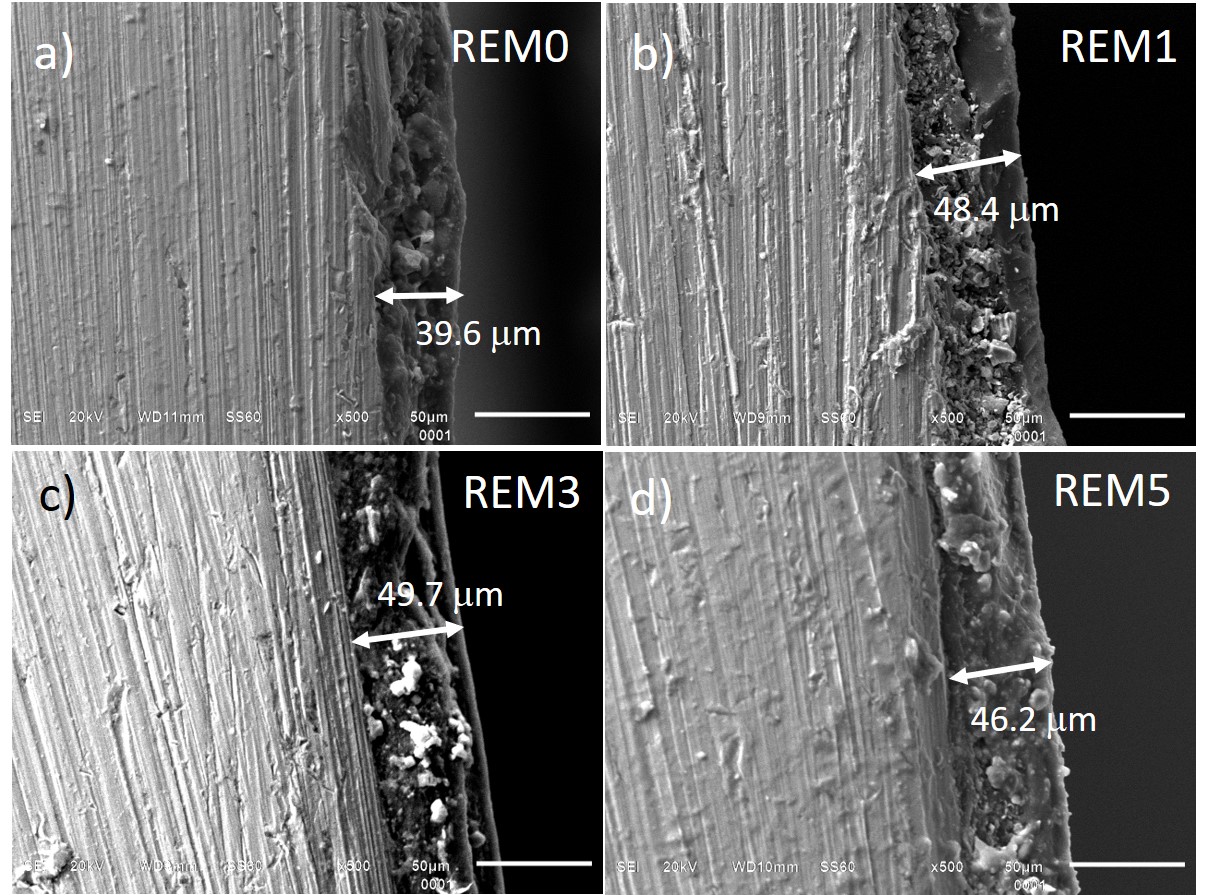
This paper studies the effect of incorporating pristine montmorillonite (MMT) on a commercial water-borne epoxy resin. MMT was dispersed in a commercial water-borne epoxy resin at concentrations of 0 wt%, 1 wt%, 3 wt% and 5 wt%. The resultant materials were deposited on carbon steel substrates, followed by the use of a 5 wt% aqueous NaCl electrolyte, to evaluate the effectiveness of their protective coating function. Scanning electron microscopy (SEM) analysis showed that the MMT was homogenously dispersed in the polymer matrix, resulting in flat and smooth surfaces. The coating protective properties, were evaluated by electrochemical impedance spectroscopy (EIS) at various immersion periods in the aqueous electrolyte. Analysis of the prepared samples indicated that the best protective performance among them was available with the 3 wt% MMT coating. The results obtained indicate that the addition of MMT offers better corrosion protection properties than pure water-borne epoxy resin, even after 900 h of exposure to NaCl solution.
Downloads
References
[1]. J. Kim, W. Lim, Y. Lee, S. Kim, S.-R. Park, S.K. Suh, I. Moon, “Development of Corrosion Control Document Database System in Crude Distillation Unit” Ind. Eng. Chem. Res. 50, 8272 (2011).
https://doi.org/10.1021/ie101871a
[2]. C. Hansson, “The Impact of Corrosion on Society” Metall. Mater. Trans. A 42, 2952 (2011).
https://doi.org/10.1007/s11661-011-0703-2
[3]. S. Wang, H.M. Ang, M.O. Tade, “Volatile organic compounds in indoor environment and photocatalytic oxidation: state of the art” Environ. Int. 33, 694 (2007).
https://doi.org/10.1016/j.envint.2007.02.011
[4]. D. Akram, E. Sharmin, S. Ahmad, “Linseed polyurethane/tetraethoxyorthosilane/fumed silica hybrid nanocomposite coatings: Physico-mechanical and potentiodynamic polarization measurements studies” Prog. Org. Coat. 77, 957 (2014).
https://doi.org/10.1016/j.porgcoat.2014.01.024
[5]. S. Miao, P. Wang, Z. Su, S. Zhang, “Vegetable-oil-based polymers as future polymeric biomaterials” Acta Biomater. 10, 1692 (2014).
https://doi.org/10.1016/j.actbio.2013.08.040
[6]. M. Alam, D. Akram, E. Sharmin, F. Zafar, S. Ahmad, “Vegetable oil based eco-friendly coating materials: A review article” Arab. J. Chem. 7, 469 (2014).
https://dx.doi.org/10.1016/j.arabjc.2013.12.023
[7]. S. Pathan, S. Ahmad, “Synergistic Effects of Linseed Oil Based Waterborne Alkyd and 3-Isocynatopropyl Triethoxysilane: Highly Transparent, Mechanically Robust, Thermally Stable, Hydrophobic, Anticorrosive Coatings” ACS Sustain. Chem. Eng. 4, 3062 (2016).
https://doi.org/10.1021/acssuschemeng.6b00024
[8]. M. Boruah, P. Gogoi, B. Adhikari, S.K. Dolui, “Advanced Antimicrobial Materials and Applications: Maleic Anhydride Antimicrobial Polymers” Prog. Org. Coat. 74, 596 (2012).
https://doi.org/10.1007/978-981-15-7098-8_7
[9]. S. Zafar, U. Riaz, S. Ahmad, “Water-borne melamine–formaldehyde-cured epoxy–acrylate corrosion resistant coatings” J. Appl. Polym. Sci. 107, 215 (2008).
https://doi.org/10.1002/app.27022
[10]. H. Xu, F. Qiu, Y. Wang, W. Wu, D. Yang, Q. Guo, “UV-curable waterborne polyurethane-acrylate: preparation, characterization and properties” Prog. Org. Coat. 73, 47 (2012).
https://doi.org/10.1016/j.porgcoat.2011.08.019
[11]. S. Huo, X. Guan, J. Li, X. Zhang, J. Li, Y. Peng, A. Gong, H. Xie, S. Chen, Q. Zhang, “Characteristics of VOCs in coating materials manufacturing and contributions to environmental implication based on on-site sampling in Shandong Province” J. Environ. Sci. 160, 497 (2026).
https://doi.org/10.1016/j.jes.2025.05.014
[12]. P. Slobodian, P. Riha, P. Saha, “A highly-deformable composite composed of an entangled network of electrically-conductive carbon-nanotubes embedded in elastic polyurethane” Carbon 10, 3446 (2012).
https://doi.org/10.1016/j.carbon.2012.03.008
[13]. S. Lucic-Blagojevic, Z. Buhin, A. Pustak, R. Lukic-Kovacic, “Influence of nanosilica on the morphology, thermal and mechanical properties of polyurethane elastomer” J. Appl. Polym. Sci. 125, E181 (2012).
https://doi.org/10.1002/app.36290
[14]. A. Barick, D. Tripathy, “Nanostructure morphology and dynamic rheological properties of nanocomposites based on thermoplastic polyurethane and organically modified montmorillonite” Polym. Bull. 66, 1231 (2011).
https://doi.org/10.1007/s00289-010-0395-6
[15]. M. Špirkova, J. Pavlicevic, A. Strachota, R. Poreba, O. Bera, L. Kapralkova, J. Baldrian, M. Slouf, N. Lazic, J. Budinski-Simendic, “Novel polycarbonate-based polyurethane elastomers: Composition–property relationship” Eur. Polym. J. 47, 959 (2011).
https://doi.org/10.1016/j.eurpolymj.2011.01.001
[16]. H. Kim, Y. Miura, C.W. Macosko, “Graphene/Polyurethane Nanocomposites for Improved Gas Barrier and Electrical Conductivity” Chem. Mater. 22, 3441 (2010).
https://doi.org/10.1021/cm100477v
[17]. Y. Assem, A.I. Khalaf, A.M. Rabia, A.A. Yehia, T.A. Zidan, “Poly(diallyldimethylammonium chloride)/clay nanocomposites: effect of molecular weight and concentration of polymer on the structural, thermal, and dielectric properties” Polym. Bull. 74, 3015 (2017).
https://doi.org/10.1007/s00289-016-1873-2
[18]. M.R. Bagherzadeh, F. Mahdavi, “Preparation of epoxy–clay nanocomposite and investigation on its anti-corrosive behavior in epoxy coating” Prog. Org. Coat. 60, 117 (2007).
https://doi.org/10.1016/j.porgcoat.2007.07.011
[19]. F.L. Jin, X. Li, S.J. Park, “Synthesis and application of epoxy resins: A review” J. Ind. Eng. Chem. 29, 1 (2015).
https://doi.org/10.1016/j.jiec.2015.03.026
[20]. A.N. Khan, A. Hayder, W.T. Chuang, “Mechanism of Intercalation Extent in Polymer/Clay Nanocomposites” Arab. J. Sci. Eng. 40, 3373 (2015).
https://doi.org/10.1007/s13369-015-1845-0
[21]. I. Miturska-Baranska, A. Rudawska, “Influence of montmorillonite on the structure and mechanical properties of epoxy coatings” Int. J. Adhes. Adhes. 145, 104210 (2026).
https://doi.org/10.1016/j.ijadhadh.2025.104210
[22]. L. Guo, C. Li, “Preparation of organically modified montmorillonite reinforced gelatin/cassava starch film and its application in broccoli florets preservation” Food Packag. Shelf Life 52, 101604 (2025).
https://doi.org/10.1016/j.fpsl.2025.101604
[23]. M.O.M. Danyliak, B.M. Datsko, “Inhibition properties of the anti-corrosion pigment based on the natural montmorillonite in epoxy coating on steel” Mater. Sci. 61, 95 (2025).
https://doi.org/10.1007/s11003-025-00967-y
[24]. Y. Chen, W. Bai, J. Chen, X. Chen, J. Zhao, F. Wei, R. Jian, X. Zheng, Y. Xu, “In-situ intercalation of montmorillonite/urushiol titanium polymer nanocomposite for anti-corrosion and anti-aging of epoxy coatings” Prog. Org. Coat. 165, 106738 (2022).
https://doi.org/10.1016/j.porgcoat.2022.106738
[25]. Mohammadi, M. Izadi, T. Shahrabi, D. Fathi, A. Fateh, “Enhanced epoxy coating based on cerium loaded Na-montmorillonite as active anti-corrosive nanoreservoirs for corrosion protection of mild steel: Synthesis, characterization, and electrochemical behavior” Prog. Org. Coat. 131, 119 (2019).
https://doi.org/10.1016/j.porgcoat.2019.02.016
[26]. X. Li, Y. Shao, Y. Wang, J. Wang, “Eco-friendly design of active montmorillonite nanofillers for reinforcing the anti-corrosion property of epoxy coating” Appl. Clay Sci. 267, 107739 (2025).
https://doi.org/10.1016/j.clay.2025.107739
[27]. R.R. Henriques, J.C. Carelo, B.G. Soares, “Anti-corrosive and self-healing properties of epoxy coatings loaded with montmorillonite modified with zinc-based ionic liquid” Prog. Org. Coat. 187, 108185 (2024).
https://doi.org/10.1016/j.porgcoat.2023.108185
[28]. C. Wang, C. Zhao, Y. Li, W. Yuan, Y. Huang, D. Cheng, T. Shen, J. Zhang, J. Liu, L. Jiang, C. Yang, Q. Shen, H. Yang, “Application of dual inhibitor-loaded ZIF-8 decorated montmorillonite nanocomposite toward active corrosion resistance of waterborne epoxy coatings” Appl. Surf. Sci. 697, 163021 (2025).
https://doi.org/10.1016/j.apsusc.2025.163021
[29]. G. Grundmeier, W. Schmidt, M. Stratmann, “Corrosion protection by organic coatings: electrochemical mechanism and novel methods of investigation” Electrochim. Acta 45, 2515 (2000).
https://doi.org/10.1016/S0013-4686(00)00348-0
[30]. T. Zheng, H. Xi, Z. Wang, X. Zhang, Y. Wang, Y. Qiao, P. Wang, Q. Li, Z. Li, C. Ji, X. Wang, “The curing kinetics and mechanical properties of epoxy resin composites reinforced by PEEK microparticles” Polym. Test. 91, 106781 (2020).
https://doi.org/10.1016/j.polymertesting.2020.106781
[31]. J. Mondal, A. Marques, L. Aarik, J. Kozlova, A. Simoes, V. Sammelselg, “Development of a thin ceramic-graphene nanolaminate coating for corrosion protection of stainless steel” Corros. Sci. 105, 161 (2020).
https://doi.org/10.1016/j.corsci.2016.01.013
[32]. X. Liu, J. Xiong, Y. Lv, Y. Zuo, “Study on corrosion electrochemical behavior of several different coating systems by EIS” Prog. Org. Coat. 64, 497 (2009).
Downloads
Published
Issue
Section
License
Copyright (c) 2026 The authors; licensee SMCTSM, Mexico.

This work is licensed under a Creative Commons Attribution 4.0 International License.
©2026 by the authors; licensee SMCTSM, Mexico. This article is an open access article distributed under the terms and conditions of the Creative Commons Attribution license (http://creativecommons.org/licenses/by/4.0/).