Si/Al ratio and its impact on CO2 adsorption in TiO2-Zeolite
DOI:
https://doi.org/10.47566/2025_syv38_1-251201Keywords:
new materials, high porosity, sol-gel, composites, isothermsAbstract
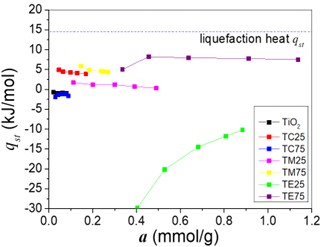
The aim of this study was to analyze the Si/Al ratio in titanium dioxide (TiO2) and Zeolite composites (Erionite, Clinoptilolite and Mordenite) and its influence on carbon dioxide (CO2) adsorption, seeking to optimize materials for greenhouse gas capture. Composites were synthesized by the sol-gel method, varying the proportions of TiO2 and zeolites (25-75 and 75-25) as a function of weight. They were characterized using techniques such as Energy Efficiency Spectroscopy (EDS) to determine the Si/Al ratio, X-ray diffraction for crystal size, and N2 adsorption for surface area. The results showed that, in most of the composites, the Si/Al ratio decreases compared to the original zeolites, except in those based on Mordenite, which maintain high values due to their greater chemical stability. The decrease in the Si/Al ratio was correlated with an increase in the CO2 affinity, especially in the TiO2-Erionite composites, which presented the lowest Si/Al values (3.29) and higher adsorption capacity. In contrast, composites with Mordenite exhibited a lower CO2 affinity, but a higher surface area (456 m2/g). In conclusion, the Si/Al ratio is a key parameter to optimize CO2 adsorption, and the intrinsic properties of each zeolite significantly affect the composite performance. These materials have potential for applications in environmental mitigation technologies.
Downloads
References
Please refer to the article for Reference list; there are some issues loading the information directly in this stage.
Downloads
Published
Issue
Section
License
Copyright (c) 2025 Karin Monserrat Alvarez Gomez, María de los Angeles Velasco Hernández, Edgar Ayala Herrera, María Dolores Guevara Espinosa, Roberto Portillo Reyes

This work is licensed under a Creative Commons Attribution 4.0 International License.
©2026 by the authors; licensee SMCTSM, Mexico. This article is an open access article distributed under the terms and conditions of the Creative Commons Attribution license (http://creativecommons.org/licenses/by/4.0/).